Cosmos
The Centre on Social Movement Studies

TEAM
Alice Mattoni, Emiliano Treré, and Diego Ceccobelli
START YEAR 2015
END YEAR 2019
OVERVIEW
PiCME – Political participation in Complex Media Environments investigates political participation in complex media environments. It does so by looking at how mechanisms and processes of political participation evolve in complex media environments and the consequences within the political sphere at large and in relation to political actors in particular.
This is a crucial topic in contemporary societies, since profound changes in the media sphere have significant impact on how political participation develops today and will evolve in the near future. In the current media environment, political actors tend to interact with a variety of communication technologies, organizations, and professionals in the political sphere. In fact, political participation – from individual involvement to electoral campaigns and protest demonstrations – is intertwined with complex flows of communication, where older and newer media technologies and their logics dispute, collide, and, more often, combine.
However, we still lack a comprehensive understanding of how mechanisms and processes in political participation actually changed in complex media environments and with what consequences for the political sphere as well as the media sphere.
PiCME seeks to fill this void through an interdisciplinary methodology that integrates diverse research traditions from media studies, Internet studies, political science, and political sociology. In doing so, the research project employs an innovative approach that is:
1) Multi-dimensional: the empirical investigation will focus on four interrelated dimensions providing an holistic explanation of political participation in complex media environments: the infrastructures, imaginations, practices, and outcomes related to media technologies employed in the context of political participation;
2) Multi-level: the empirical investigation will address three interrelated levels of analysis seldom combined in studies on political participation: the micro-level of individual citizens who become politically active despite not being affiliated to collective political actors; the meso-level of collective political actors (i.e. political parties and social movements); and the macro-level of big (digital) media corporations that shape the architecture and the affordances of complex media environments;
3) Comparative: the empirical investigation will develop a cross-country comparison focusing on three Southern European countries: Italy, Spain, and Greece. In each country, the analysis will focus on case-studies in the realm of institutional politics and in the realm of non-institutional politics;
4) Mixed methods: the empirical research will combine different methodological traditions, including expert and in-depth interviewing; digital and non-digital ethnography; frame and discourse analysis; and statistical analysis.
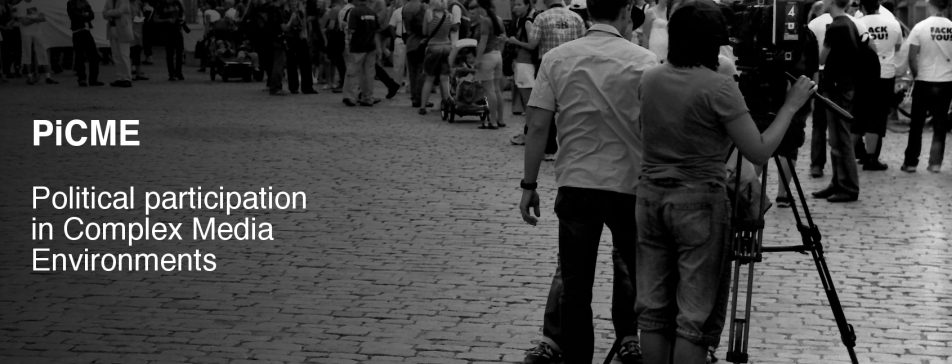
*Original picture by Robin Iversen released under the CC License Attribution 2.0 Generic and here partially cut and modified with Gimp.
FUNDING
Funded by the Italian Ministry of Education, University and Research through the grant S.I.R. – Scientific Independence of young Researchers.
Codice Unico Progetto: E52I15000500001. Codice Cineca: RBSI14GUJE
Journal Article - 2026
Journal Article - 2026
Journal Article - 2026
Edited Volume - 2026
Journal Article - 2026
Journal Article - 2026
Monograph - 2025
Journal Article - 2025
Journal Article - 2025