logo

Cosmos

The Centre on Social Movement Studies

logo
2026-03-17

Travelling with the European Convoy for Cuba

Flotillas have become an important repertoire of protest, bridging logic of testimony and direct action of committed activists to broad expression of solidarity. Federico Alagna, a member of COSMOS, is on board of the European Convoy for Cuba and will update us on the mission.
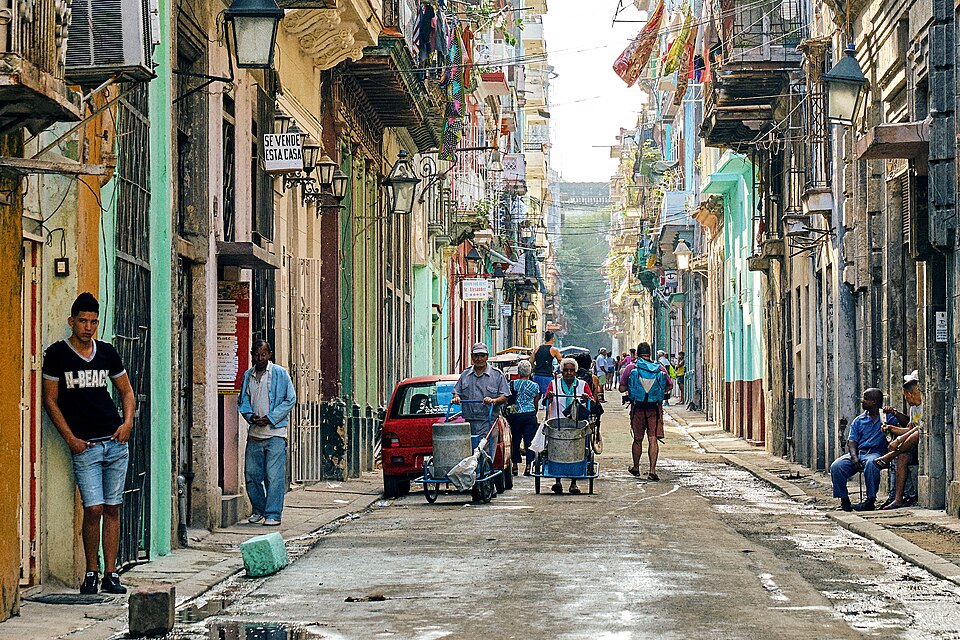
Picture description

While I write these lines, I am on a train to Milan Malpensa airport, from where I will depart in a few hours for Cuba with the European Convoy for Cuba – the air contingent of the Nuestra América Convoy, an international solidarity initiative promoted by a global coalition of associations, trade unions, and other social and political organisations. I am taking part as an activist with Mediterranea Saving Humans, a civil maritime rescue organisation, and within the broader framework of my scholar-activism.

We are setting off because we believe it is impossible to stand by and watch. After more than sixty years of United States embargo, its tightening imposed under the Trump administration has become an unbearable form of collective punishment in the daily lives of millions of people. It is a criminal choice, contrary to the most basic ethical principles and to social justice, not to mention international law. It is paralysing the country: schools and universities are being forced to close, water often no longer runs in people’s homes, and the risk of health crises and epidemics is increasing. Hospitals, already under strain, are struggling to guarantee even the most basic services. At this very moment, it appears that the island’s entire electricity system has collapsed.

Each of us is carrying two boxes of essential medicines, including oncology drugs and medical supplies, collected over recent weeks thanks to the generosity of thousands of people across Europe. In total, we will bring five tonnes of material. This is only a small drop in the ocean, as the bulk of the aid will follow in containers. In the coming days, we will meet with various organisations and communities across the island, helping to prepare the ground for the arrival of the rest of the Convoy by sea from the Mexican coast (currently expected on 21 March). There will be further solidarity activities and moments of witnessing and exchange.

Being present in Cuba at this moment is essential in order to offer concrete solidarity to the Cuban people – an enduring example of internationalist solidarity – and to reaffirm our opposition to the idea that international relations can be governed by the law of the strongest, starving an entire people into submission.

Cuba no está sola, Cuba is not alone.

Federico Alagna


News

Publications

Journal Article - 2025

Communication creates partial organization: A comparative analysis of the organizing practices of two climate action movements, Youth for Climate and Fridays for Future Italy

Marco Deseriis, Lorenzo Zamponi, Diego Ceccobelli
This article focuses on a neglected aspect of the climate action movement Fridays for Future, namely, the relationship between its mediated communication practices and its early organizational processes. Drawing from a strand of organizational communication that underscores the constitutive dimension of communication to organizing processes, we analyze the significance of mediatized leadership and networked communication for the foundation and early development of two national chapters of Fridays for Future: Youth for Climate (YFC) Belgium and Fridays for Future Italy (FFFI).

Journal Article - 2023

Resisting right-wing populism in power: a comparative analysis of the Facebook activities of social movements in Italy and the UK

Niccolò Pennucci
This paper aims to present a comparative study of the civil society reaction to right-wing populism in power through social media, by looking at cases in Italy and the United Kingdom.

Journal Article - 2023

Emotions in Action: the Role of Emotions in Refugee Solidarity Activism

Chiara Milan
This article investigates the different types of emotions that result from participation in refugee solidarity activism, investigating how they change over time and to what extent they explain why individuals remain involved in action in spite of unfavorable circumstances.

Journal Article - 2023

‘Love is over, this is going to be Turkey!’: cathartic resonance between the June 2013 protests in Turkey and Brazil

Batuhan Eren
This study addresses the question of why and how a protest can inspire individuals in distant countries. Taking the June 2013 protests in Turkey and Brazil as cases, it investigates the reasons why the Turkish protests were framed as one of the inspirational benchmarks by some Brazilian protesters.

Journal Article - 2023

Mutual aid and solidarity politics in times of emergency: direct social action and temporality in Italy during the COVID-19 pandemic

Lorenzo Zamponi
From the spring of 2020, the COVID-19 pandemic and the social distancing measures introduced created a series of social problems and needs that were partially addressed in Italy as well as in other countries by grassroots mutual aid initiatives. While many of these initiatives were strongly rooted in the Italian social movement and civil society landscape and the choice to engage in mutual aid activities was the result of long years of reflection and planning, the article shows how strongly the temporality of emergency affected the nature of these initiatives, their development and their outcomes, in particular with regard to the extraordinary number of people who volunteered and their relationship with politicisation processes.

Monograph - 2023

Populism and (Pop) Music

Manuela Caiani, Enrico Padoan
The book provides a detailed account of the links between production of popular culture to the rise of populism and contributes to studies on populism and popular culture in Italy, using a comparative approach and a cultural sociology perspective

Monograph - 2022

Labour conflicts in the digital age

Donatella della Porta, Riccardo Emilio Chesta, Lorenzo Cini
From Deliveroo to Amazon, digital platforms have drastically transformed the way we work. But how are these transformations being received and challenged by workers? This book provides a radical interpretation of the changing nature of worker movements in the digital age, developing an invaluable approach that combines social movement studies and industrial relations. Using case studies taken from Europe and North America, it offers a comparative perspective on the mobilizing trajectories of different platform workers and their distinct organizational forms and action repertoires.

Monograph - 2022

Resisting the Backlash: Street Protest in Italy

Donatella della Porta, Niccolò Bertuzzi, Daniela Chironi, Chiara Milan, Martín Portos & Lorenzo Zamponi
Drawing interview material, together with extensive data from the authors’ original social movement database, this book examines the development of social movements in resistance to perceived political "regression" and a growing right-wing backlash.

Journal Article - 2021

Learning from Democratic Practices: New Perspectives in Institutional Design

Andrea Felicetti
Drawing from literature on democratic practices in social movements and democratic innovations, the article illustrates three ways to advance institutional design in the wake of the systemic turn.

Journal Article - 2021

Populism between voting and non-electoral participation

Andrea Pirro & Martín Portos
The article focuses on a neglected aspect of populist mobilisation, i.e. non-electoral participation (NEP), and elaborates on the extent to which populist party voters engage politically outside the polling station. While challenging common understandings of populism as inherently distrustful and apathetic, and protest as an exclusive practice of the left, the study critically places NEP at the heart of populism in general, and populist right politics in particular.