Cosmos
The Centre on Social Movement Studies

Mining corporations and conglomerates have, over centuries, been a key source of appropriation as well as a driver for high levels of inequality
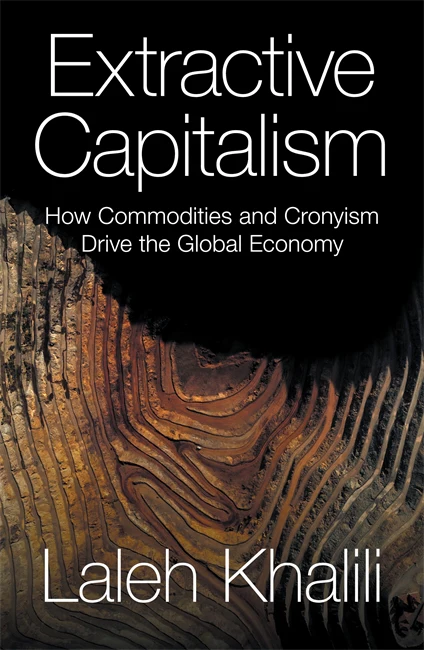
From bird guano to be used as fertilizer to rare earths, the world economy and our everyday lives were dependent, and they still are, on raw materials. The mining or collection, storage, transport and commercialization of raw materials and primary commodities is at the core of Extractive Capitalism, How Commodities and Cronyism Drive the Global Economy (2025) professor Laleh Khalili’s latest book which she discussed with the SNS Social sciences class on January 9th.
Blending anecdotes from her professional life outside academia and research, Khalili work reminds us how much the economy depends on the extraction of raw materials that are traded as commodities, producing vast profits from all corners of the world to a narrow pool of investors while externalizing costs on to workers, communities and the environment.
As Khalili writes in the introduction of the book:
“What is extractive capitalism? Primary commodities like sand, iron ore, bauxite, coal – and of course oil – are excavated, transported, refined or assayed, and then sold on at great markup. Where labour is unionised and legally protected, the process of extraction is increasingly automated. Where labour – or life – is cheap, many of the steps in the process of extraction are still performed manually. Think of ship-breaking in South Asia or stevedoring in Africa, which still rely on the power of human muscles rather than gleaming high-tech machinery. To understand how our globally and locally unequal world was made, extractive capitalism holds many of the answers”.
The example Professor Khalili made in Firenze is the way oil was and is transported: first tankers were coal fueled and carried barrels, both the fuel and the loading and unloading needed many dozens of people on board and at the docks, this is not the case anymore. This transition started very early, as the first oil fueled tankers were commissioned by the Nobel family in the last decades of the XIX century.
More from Khalil’s introduction:
Modern capitalism has its roots in colonialism. The dispossession of indigenous people in Asia, Africa and Latin America enabled colonisers to take control of resources and expand international trade. The enslavement and transportation of millions of Africans across oceans and the extraction of resources gave rise to the global market.
The United States in particular depended on the abundance of dispossessed indigenous lands and resources, coercively extracted enslaved labour, and the work of ever-increasing numbers of immigrants as the kernel of its particularly voracious brand of capitalism. So many of today’s business practices, from the management of time and manufacturing lines to modern forms of business accounting, insurance calculations and mortality tables, were devised to facilitate colonialism and chattel slavery. These practices were adapted to an industrial world fuelled and fed first by coal, and later by oil.
The book, in fact, is also a history of Labour and the way it was exploited from the times when it was also a commodity – as in the plantations of Southern US, where slaves where both something you could buy and sell and a workforce – to the attempt of minimizing the human workforce contribution to production through the use of robots and AI in contemporary advanced capitalism societies. Another form, again using the shipping industry as an example, is the racialization of the maritime labour force or the use of former colony flags for ships that carry goods owned by western companies. Again, the goal is to save on labour cost and rights.
Being also a scholar who studied social movements, Khalili also tells the story of resistance to extractive capitalism, such as that against the Dakota Access pipeline when the native local tribes led a protest to protect the sacred site of Standing Rock.
Professors Della Porta (SNS) and Meardi (SNS) also took part to the discussion on the book. Speaking about social movements and the mobilization for Gaza and using the example of the central role the Genova dockers, played in the Global Sumud Flotilla. Della Porta pointed at the importance of the Mediterranean sea as a place of contentious action. Pointing however at very different degrees of mobilization in different degrees of participation in protest against weapon trade in harbours located in different countries, she asked Khalil to explain the huge differences in the reaction of dockers in a cross-national comparative perspective. According to Khalil there are many factors: the distance of many European ports from the city, that is from a community, less interaction between the workplace and society; labour laws in many countries (she used the UK example) that restrict the tools for Unions to protest and mobilize; the presence of a large part of labour coming from outside the community where ports are.
Professor Meardi pointed at the global value chain of shipbuilding as part of the sea economy that Khalili describes through the lens of extractive capitalism. He noticed how ship building has almost disappeared in Europe with the exception of few segments such as yachts, cruise ships and warships. In these segments production facilities have been kept by importing a large part of the workforce and creating an ethnic hierarchy of workers – most notably in the Fincantieri shipyards in Italy where the majority of production workers are from Bangladesh – not by chance, because Bangladesh had already been integrated in the global shipbuilding economy as the main site for shipbreaking – a labour intensive and environmentally hazardous activity. An indirect confirmation of Khalil’s thesis on extraction from both nature and human labour.
Journal Article - 2025
Journal Article - 2023
Journal Article - 2023
Journal Article - 2023
Journal Article - 2023
Monograph - 2023
Monograph - 2022
Monograph - 2022
Journal Article - 2021
Journal Article - 2021