Cosmos
The Centre on Social Movement Studies

The purpose of the volume is twofold. First, the crises outlined above made a new critical political economy assessment of European integration of utmost importance to understand of where Europe is heading. Second, we used this volume to start tackling some of the theoretical blindspots of earlier critical political economy research on European integration.
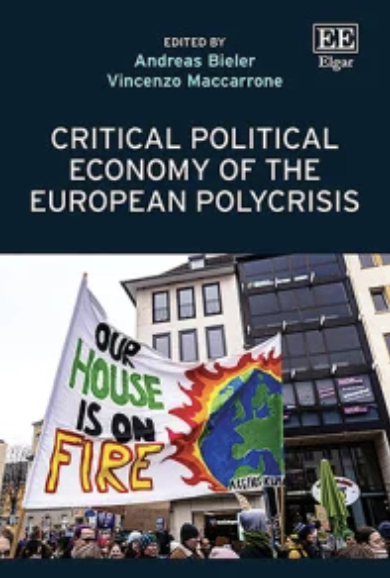
Andreas Bieler, University of Nottingham/Vincenzo Maccarrone, Scuola Normale Superiore
Over the last two decades, the European Union (EU) has faced a series of intertwined crises, including the Global Financial Crisis in 2008 and the structural adjustment programmes imposed by the EU and the IMF on several member states; the increase of flows of refugees triggered by war and famines and the humanitarian disaster caused by Fortress Europe; Brexit and the rise of Euroscepticism. In turn, new crises have emerged and further intensified the previous ones: the Covid-19 pandemic, the war in Ukraine and the impending climate catastrophe. To capture the multiple, interrelated, and self-reinforcing characters of the crises affecting global capitalism and European integration, the term ‘polycrisis’ – originally coined by the French complex theorists Edgar Morin and Anne Brigitte Kern – has become increasingly popular, both among scholars and European elites alike (Tooze, 2022). As we argue in our recently published co-edited volume, Critical Political Economy of the European Polycrisis (Edward Elgar, 2025), Critical Political Economy (CPE) is well placed to contribute to this debate. In this blog post, we will outline the purpose underpinning this volume and present some of the key findings.
The purpose of the volume is twofold. First, the crises outlined above made a new critical political economy assessment of European integration of utmost importance to understand of where Europe is heading. Second, we used this volume to start tackling some of the theoretical blindspots of earlier critical political economy research on European integration.
As for the former, since 2001 there have been regular instalments of co-edited volumes assessing the state of European integration from a critical political economy perspective, providing important correctives to liberal and state-centric analyses alike. The volume Social Forces in the Making of the New Europe (Palgrave) by Andreas Bieler and Adam David Morton in 2001 was followed by the volumes co-edited by Alan Cafruny and Magnus Ryner (Rowman & Littlefield, 2003), by Henk Overbeek (Routledge, 2003), by Bastiaan van Apeldoorn, Jan Drahokoupil and Laura Horn (Palgrave, 2009), by Nousios Petros, Henk Overbeek and Andreas Tsolakis (Routledge, 2012), by Amandine Crespy and Georg Menz (Palgrave, 2015), by Johannes Jäger and Elisabeth Springler (Routledge 2015) as well as by Stefanie Wöhl, Elisabeth Springler, Martin Pachel and Bernhard Zeilinger (Springer, 2020). Recent dynamics around capitalist crises, climate change and intensified geo-political confrontations made a new volume absolutely essential.
While an empirical update was clearly necessary, this new volume also provided an opportunity of reflecting about critical political economy theory itself. Influenced by the work of Robert Cox (e.g. 1987) and Kees van der Pijl (1984), critical political economy, initially also referred to as neo-Gramscian perspectives or Amsterdam School of Historical Materialism, informing these various edited volumes was characterized by a number of shared conceptual assumptions. First, it focused on the contents of European integration. Unlike the mainstream’s emphasis on the form of integration with neo-functionalism predicting ever further integration and intergovernmentalists asserting the continuing centrality of states, critical political economy approaches analysed the contents and normative purpose of integration, the way how neo-liberal restructuring underpinned the revival of European integration since the mid-1980s around the 1985 Internal Market project and the 1992 Treaty of Maastricht including an agreement on Economic and Monetary Union.
Moreover, these approaches shared a commitment to a historical materialist analysis of class struggle as heuristic device when analysing European integration. Importantly, this emphasised the struggle between capital and labour, but also dynamics of intra-class struggle between different class fractions of capital and labour, highlighting the emergence of (European) transnational capital as the dominant or even hegemonic class fraction driving the project of (embedded) neo-liberal restructuring in the EU (e.g. Bieler 2000; van Apeldoorn 2002). Finally, there has been a clear commitment to an emancipatory project. As these analyses focused on the social purpose, the normative dimension underpinning European integration, there was an automatic focus on what European integration should look like in line with principles of social justice. Hence, significant research also focused on social class forces of resistance against capital driven neo-liberal restructuring.
While conceptually advanced in view of mainstream neo-functionalist and intergovernmentalist analyses, there were, however, also significant theoretical blindspots. First, even though Walter Rodney had already published his masterful study of How Europe Underdeveloped Africa in 1972 (Verso 1972/2018), the colonial legacy of European integration and the literature around racial capitalism played no role in earlier critical political economy research on European integration. Equally, it was Italian feminists, who had launched the Wages for Housework campaign in 1974 (see Callaci 2025), and yet issues of social reproduction were not taken into account. Finally, the Club of Rome had already published its study on The Limits to Growth in 1972, but environmental destruction did not play a major role in analyses of European integration either.
Hence, in this volume we also wanted to contribute to tackling these theoretical blindspots with several contributions emphasising the racist and patriarchal forms of oppression as well as the relentless destruction of nature as part of European integration. Nikolai Huke’s chapter shows the necessity of incorporating discussions of migration, borders, and racism into academic debates surrounding “European Integration in Times of Polycrisis”’. In his analysis of footwear production in Apulia (Italy) and Albania, Francesco Bagnardi highlights how capital takes advantage of gendered and racialised relations of production and social reproduction, by relying on highly exploited, feminised labour to lower production costs.
A common theme that emerges across the chapters of the book is that neoliberalism, ‘understood as [a] political project that seeks to dis-embed capital from the great part of the web of social, political and regulatory constraints, and democratic control, and accountability’ (Angela Wigger), continues to be hegemonic in Europe, albeit showing crises-tendencies. This emerges clearly from the analysis of EU fiscal and industrial policy. The former, as Magnus Ryner argues, continues to serve the purpose of subordinating social objectives to the need to provide a stable macroeconomic framework. The latter, as highlighted by Angela Wigger, allows to open new frontiers for accumulation for private companies, without carrying the associated risk. A similar dynamic is highlighted by Rubén Vezzoni’s analysis of the EU Energy Union. As Ewa Dziwok and Johannes Jäger argue, neoliberalism remains dominant also within the emerging EU green economy. Reformist strategies have been unable, to date, to shift the general direction of integration.
Moreover, the EU’s new economic governance framework introduced after the 2008 Global Financial Crisis granted the EU new powers of intervention to commodify public services, as shown by Costanza Galanti and Stella Christou in the case of healthcare and by Darragh Golden in the case of local public services. Rosalind Cavaghan argues that even when the European Semester – the EU’s post-GFC tool for coordinating economic and social policies of the member states – acknowledges gender equality issues – profit maximisation trumps concerns with social reproduction. While relying on unpaid labour for its reproduction, capital seeks constantly to commodify areas of social reproduction as new profitable investment. Beyond healthcare and local public services, this is also the case of housing in Europe, as it emerges from the chapters by Giuseppe Montalbano and Lindsay Flynn and by Stefanie Wöhl.
The book has also a strong emphasis on the uneven and combined nature of European integration. Elif Uzgören sheds light on Turkey’s informal integration into the European political economy via market liberalisation and deregulation. Alan Cafruny and Vassilis Fouskas show how the war in Ukraine and US mercantilist policies are re-composing and re-organizing global capital in the geography of North American and Chinese orbits, while Europe, and in particular Germany, stagnate. Andreas Bieler’s analysis of the opposition to the trade agreement between the EU and the Mercosur countries Argentina, Brazil, Paraguay and Uruguay provides evidence on the dynamics of unequal exchange underlying the agreement. Julia Eder and Jakob Rammer make clear how the EU’s efforts at transitioning to green energy lock Chile into a situation in which it is both dependent on EU foreign capital and technology as well as the EU as a market for its exports of green hydrogen. Assessing the provisions of the EU’s Corporate Sustainability Due Diligence directive, Riccardo Fornasari and Vincenzo Maccarrone argue that due to its structural limitations it cannot alter the unequal exchange between Global North and Global South.
Various chapters also analyse what is perhaps the most significant political development in Europe over recent years, and a symptom of polycrisis: the rise of the far right. Daniela Caterina, Adriano Cozzolino, Gemma Gasseau and Davide Monaco show how in Italy a long process of neo-liberal restructuring of Berlusconism eventually resulted in a right-wing government led by the fascist Fratelli d’Italia of Giorgia Meloni. Jasper P. Simons, Miklós Sebők and Ilona Szabó show how Viktor Orbán managed to build a project of ‘illiberal counterhegemony’, which, however, ‘failed to form a truly cohesive transnational political class with a unified agenda’. Owen Worth argues that, far from challenging the hegemony of neoliberalism, far-right parties ‘have largely failed to initiate any meaningful transformation’. In fact, as Nikolai Huke’s chapter demonstrates, the rise of the far right can be interpreted as an attempt to defend the existing Imperial Mode of Living, built on the EU’s neoliberal political economy.
Since we closed our volume, crises conditions within and outside the EU have intensified. And yet, paraphrasing Rosa Luxemburg, the future of humanity will unfold within the possibilities of barbarism versus (eco)socialism. CPE analyses will remain important for tracing future European integration and uncovering cracks and contradictions within the capitalist European political economy, which may provide space for resistance and progressive alternatives.
Andreas Bieler is Professor of Political Economy at the University of Nottingham, UK and co-Director of the independent Centre for the Study of Social and Global Justice (CSSGJ). His publications include Fighting for Water: Resisting Privatization in Europe (Zed Books, 2021) and (together with Adam David Morton) Global Capitalism, Global War, Global Crisis (CUP, 2018).
Vincenzo Maccarrone is Assistant Professor at the Faculty of Political and Social Sciences at the Scuola Normale Superiore in Florence, Italy. His research interests intersect labour sociology and political economy.
Journal Article - 2025
Journal Article - 2023
Journal Article - 2023
Journal Article - 2023
Journal Article - 2023
Monograph - 2023
Monograph - 2022
Monograph - 2022
Journal Article - 2021
Journal Article - 2021