Cosmos
The Centre on Social Movement Studies

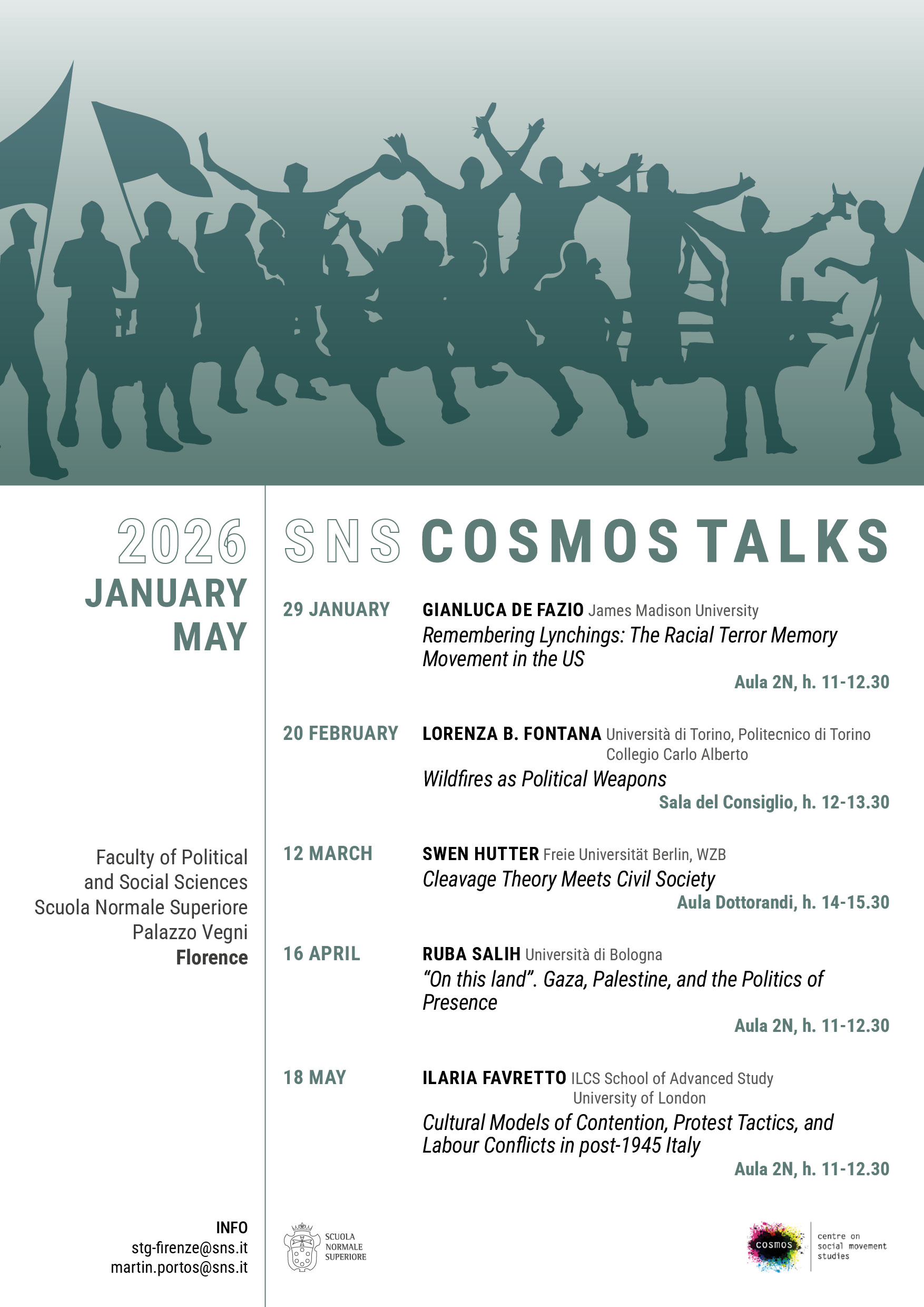
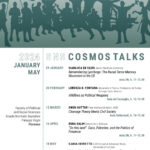
The winter program for our Cosmos Talks is here
– 29th January, 11-12.30h. 2N Room, Palazzo Vegni
Gianluca de Fazio (James Madison University, USA), Remembering Lynchings: The Racial Terror Memory Movement in the US
This talk explores the rise of a memory movement over the past two decades that seeks to publicly acknowledge and memorialize lynching as a form of racial violence. Following the unexpected success of the 2005 “Without Sanctuary” exhibit of lynching photographs, local communities, museums, and national organizations such as the Equal Justice Initiative have reframed lynching from a silenced atrocity to a central narrative in American racial history. Drawing on memory studies and social movement scholarship, I examine one key commemorative strategy: historical markers honoring lynching victims. These markers aim to confront collective amnesia and offer a counternarrative to the Lost Cause ideology and commemorative landscape that dominate the United States, particularly in the South.
– 20th February, 12-13.30h. Sala del Consiglio, Palazzo Vegni
Lorenza B. Fontana (Università di Torino/ Politecnico di Torino/ Collegio Carlo Alberto), Wildfires as Political Weapons
Under what conditions do wildfires become politicized and weaponized? What socio-ecological characteristics of wildfires make them particularly amenable to political manipulation? How are blame and responsibility for fire events assigned and contested, and what do these processes reveal about broader struggles over land, identity, and power? This paper examines how wildfires can be transformed into political weapons, focusing on the case of Bolivia’s Chiquitania region. While fire has long been treated within ecological and disaster-management frameworks, we argue that its socio-political dimensions remain underexplored.
– 12th March, 14-15.30h. Dottorandi Room, Palazzo Vegni
Swen Hutter (Freie Universität Berlin/ WZB), Cleavage Theory Meets Civil Society
How does civil society shape the development of cleavages today? While intermediary organizations such as trade unions and churches featured prominently in historical accounts, neo-cleavage theory has paid limited attention to the meso-level dynamics of the emerging ‘transnational’ divide beyond party politics. This talk presents a framework for analyzing how civil society contributes to cleavage formation through two mechanisms: by structuring group–party linkages on the supply side and by fostering social closure on the demand side.
– 16th April, 11-12.30h. 2N Room, Palazzo Vegni
Ruba Salih (Università di Bologna), “On this land”. Gaza, Palestine, and the Politics of Presence
– 18th May, 11-12.30h. 2N Room, Palazzo Vegni
Ilaria Favretto* (ILCS, School of Advanced Study, University of London), Cultural models of contention, protest tactics, and labour conflicts in post-1945 Italy
The history of the twentieth century in Italy is marked by industrial unrest. And yet, our knowledge of the cultures that informed those protests and, equally important, of the forms they took is still limited, leaving important questions unanswered on their meanings, functions, mechanisms of transmission, continuities, and discontinuities with earlier waves of mobilization and global connections. In this paper, Favretto will explore the protest methods and the underpinning protest cultures of Italian industrial workers from the collapse of Fascism to the present day. Challenging common portrayals of the labour movement as unimaginative and conventional in its tactics, she will demonstrate the variety of forms of industrial protest, encompassing actions such as sit-ins, protest camps, and hunger strikes, which are typically not associated with industrial conflict.
Journal Article - 2025
Journal Article - 2023
Journal Article - 2023
Journal Article - 2023
Journal Article - 2023
Monograph - 2023
Monograph - 2022
Monograph - 2022
Journal Article - 2021
Journal Article - 2021