logo

Cosmos

The Centre on Social Movement Studies

logo
2026-02-09

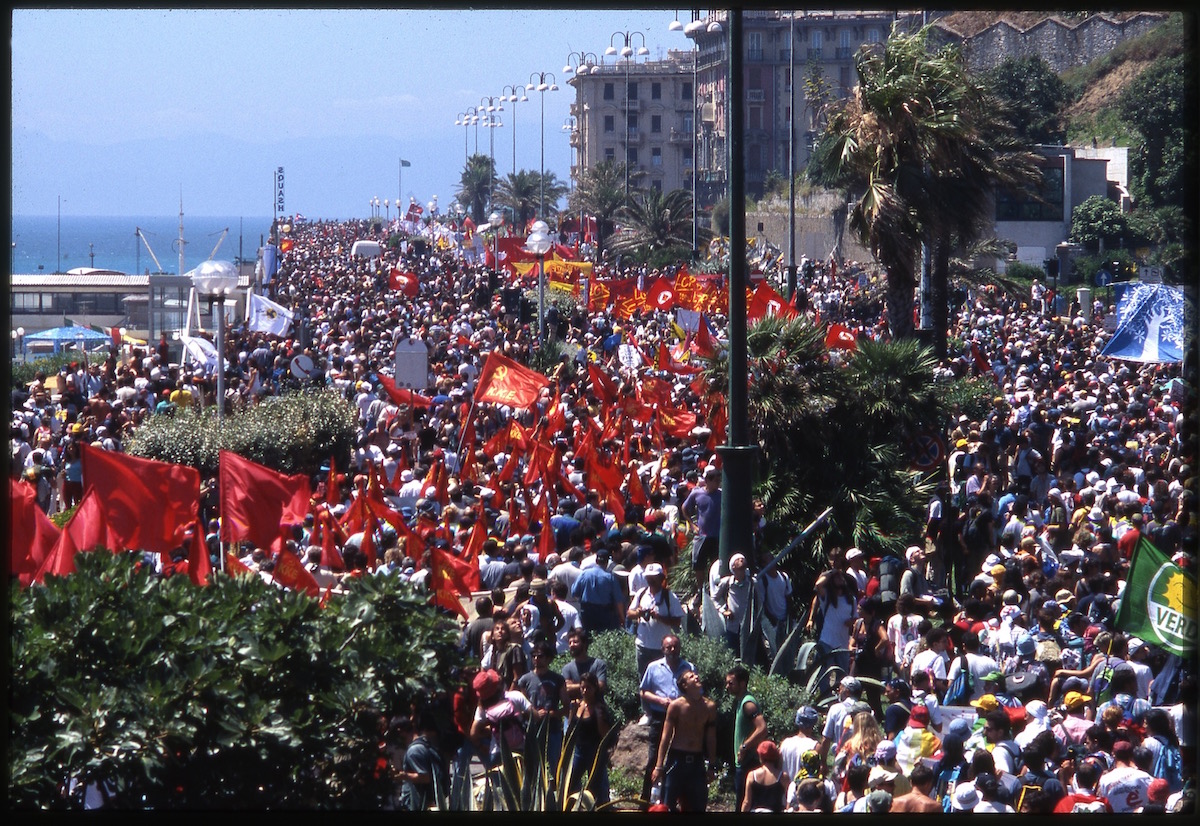
Genova 2001 in historical perspective, a conference and a call for papers

Picture description

The Italian-German Historical Institute of the Fondazione Bruno Kessler (FBK) is organising a conference on 19-20 November 2026 entitled Europe in Movement(s). Genoa 2001 and Transnational Mobilisations in Historical Perspective. Proposals are invited.

The G8 summit in Genoa (19-22 July 2001) is often described as the high point of the international mobilisation against neoliberal globalisation and, at the same time, as a watershed in the history of social movements in Europe. The protests, the death of Carlo Giuliani, the violence and torture later recognised by the European Court of Human Rights, as well as the long legal proceedings, have made Genoa a crucial laboratory for understanding relations between movements, states, and supranational bodies at the dawn of the twenty-first century. At the same time, scholarship on the Global Justice Movement and the alter-globalisation movement has highlighted the transnational and strongly European character of this cycle of protest: networks such as the Association for the Taxation of Financial Transactions and for Citizens’ Action (Attac), the Genoa Social Forum, the Indymedia networks, and the World and European Social Forums redefined democratic practices, organisational forms, and political imaginaries that continued to circulate well beyond 2001 and fuelled subsequent mobilisations against war, against austerity, for the climate, and for the rights of migrants.

Keynote speakers
Donatella Della Porta (Scuola Normale Superiore)
Ilaria Favretto (Institute of Languages, Cultures and Societies, School of Advanced Study, University of London/Kingston University)

Submission guidelines
Interested scholars are invited to submit:
a) An abstract (maximum 400-500 words, in English or Italian) including:
• title of the paper;
• research question and theoretical framework;
• sources and methodology;
• main expected results.
b) A short CV (max. 2 pages) including institutional affiliation, main relevant publications, and email address.

The application, complete with all required documentation, must be sent in pdf format by email to the following address: europeinmovements@fbk.eu by 12:00 (noon) CET on 2 March 2026.

Conference grants
A total of 9 conference grants will be awarded.
Each grant will be paid in a single instalment, up to a maximum of €300, as reimbursement to cover documented travel and accommodation expenses. Meals (the conference dinner on 19 November 2026) will be covered by the institute hosting the conference.
Where possible, the Foundation reserves the right to increase the number of grants during the same period and for the same purpose, with the aim of supporting and recognising a greater number of deserving proposals.

Selection and publication
Proposals will be evaluated by the scientific committee on the basis of:
• Relevance and scholarly quality of the proposal, taking into account the originality of the contribution and its potential impact on the academic community.
• Academic and professional background, with particular reference to research experience, publications, and institutional affiliations.

The outcome of the selection will be communicated by mid-March 2026.
Those whose proposals are accepted must confirm their acceptance or withdrawal within 7 working days of receiving the acceptance notification.

Scientific committee
Donatella Della Porta (Scuola Normale Superiore); Cecilia Nubola (FBK – Italian-German Historical Institute); Giulio Taccetti (University of Turin).

For any further information, please write to: europeinmovements@fbk.eu

News

Publications

Journal Article - 2025

Communication creates partial organization: A comparative analysis of the organizing practices of two climate action movements, Youth for Climate and Fridays for Future Italy

Marco Deseriis, Lorenzo Zamponi, Diego Ceccobelli
This article focuses on a neglected aspect of the climate action movement Fridays for Future, namely, the relationship between its mediated communication practices and its early organizational processes. Drawing from a strand of organizational communication that underscores the constitutive dimension of communication to organizing processes, we analyze the significance of mediatized leadership and networked communication for the foundation and early development of two national chapters of Fridays for Future: Youth for Climate (YFC) Belgium and Fridays for Future Italy (FFFI).

Journal Article - 2023

Resisting right-wing populism in power: a comparative analysis of the Facebook activities of social movements in Italy and the UK

Niccolò Pennucci
This paper aims to present a comparative study of the civil society reaction to right-wing populism in power through social media, by looking at cases in Italy and the United Kingdom.

Journal Article - 2023

Emotions in Action: the Role of Emotions in Refugee Solidarity Activism

Chiara Milan
This article investigates the different types of emotions that result from participation in refugee solidarity activism, investigating how they change over time and to what extent they explain why individuals remain involved in action in spite of unfavorable circumstances.

Journal Article - 2023

‘Love is over, this is going to be Turkey!’: cathartic resonance between the June 2013 protests in Turkey and Brazil

Batuhan Eren
This study addresses the question of why and how a protest can inspire individuals in distant countries. Taking the June 2013 protests in Turkey and Brazil as cases, it investigates the reasons why the Turkish protests were framed as one of the inspirational benchmarks by some Brazilian protesters.

Journal Article - 2023

Mutual aid and solidarity politics in times of emergency: direct social action and temporality in Italy during the COVID-19 pandemic

Lorenzo Zamponi
From the spring of 2020, the COVID-19 pandemic and the social distancing measures introduced created a series of social problems and needs that were partially addressed in Italy as well as in other countries by grassroots mutual aid initiatives. While many of these initiatives were strongly rooted in the Italian social movement and civil society landscape and the choice to engage in mutual aid activities was the result of long years of reflection and planning, the article shows how strongly the temporality of emergency affected the nature of these initiatives, their development and their outcomes, in particular with regard to the extraordinary number of people who volunteered and their relationship with politicisation processes.

Monograph - 2023

Populism and (Pop) Music

Manuela Caiani, Enrico Padoan
The book provides a detailed account of the links between production of popular culture to the rise of populism and contributes to studies on populism and popular culture in Italy, using a comparative approach and a cultural sociology perspective

Monograph - 2022

Labour conflicts in the digital age

Donatella della Porta, Riccardo Emilio Chesta, Lorenzo Cini
From Deliveroo to Amazon, digital platforms have drastically transformed the way we work. But how are these transformations being received and challenged by workers? This book provides a radical interpretation of the changing nature of worker movements in the digital age, developing an invaluable approach that combines social movement studies and industrial relations. Using case studies taken from Europe and North America, it offers a comparative perspective on the mobilizing trajectories of different platform workers and their distinct organizational forms and action repertoires.

Monograph - 2022

Resisting the Backlash: Street Protest in Italy

Donatella della Porta, Niccolò Bertuzzi, Daniela Chironi, Chiara Milan, Martín Portos & Lorenzo Zamponi
Drawing interview material, together with extensive data from the authors’ original social movement database, this book examines the development of social movements in resistance to perceived political "regression" and a growing right-wing backlash.

Journal Article - 2021

Learning from Democratic Practices: New Perspectives in Institutional Design

Andrea Felicetti
Drawing from literature on democratic practices in social movements and democratic innovations, the article illustrates three ways to advance institutional design in the wake of the systemic turn.

Journal Article - 2021

Populism between voting and non-electoral participation

Andrea Pirro & Martín Portos
The article focuses on a neglected aspect of populist mobilisation, i.e. non-electoral participation (NEP), and elaborates on the extent to which populist party voters engage politically outside the polling station. While challenging common understandings of populism as inherently distrustful and apathetic, and protest as an exclusive practice of the left, the study critically places NEP at the heart of populism in general, and populist right politics in particular.